Backup Generator Installation in Big Bear, CA: Why 6,750 Feet Changes Everything About Sizing
Backup Generator Installation in Big Bear, CA: Why 6,750 Feet Changes Everything About Sizing
Quick answer: Backup generator installation in Big Bear involves the same core steps as anywhere else — sizing, fuel source, transfer switch, permit — but elevation changes the math. At 6,750 feet, generator engines lose roughly 20–25% of their rated output compared to sea level, which means a generator sized using a standard online calculator will likely be undersized here. Add in propane-vs-natural-gas availability that varies by neighborhood and snow-load placement requirements, and generator installation in the San Bernardino Mountains needs a mountain-specific approach.
If you've lost power during a BVES PSPS event this year — and a lot of Big Bear homeowners have — you already know why this matters. Here's what actually goes into a correctly sized, correctly installed backup generator at altitude.
What Size Backup Generator Do You Need at Big Bear's Elevation?
This is the single most-overlooked factor in mountain generator sizing. Generator engines depend on atmospheric oxygen to combust fuel efficiently, and the air at Big Bear's 6,750-foot elevation is meaningfully thinner than at sea level. The general industry rule of thumb is that generator output drops approximately 3–4% for every 1,000 feet above the manufacturer's baseline elevation (typically 500–1,000 feet), meaning a generator rated for 22kW at sea level may only deliver somewhere in the range of 16–18kW once it's actually running at Big Bear Lake or Big Bear City elevation. A generator sized using a flatland calculator — or a quote from an installer who doesn't routinely work at altitude — will often leave you short on the exact night you need full output. The fix is straightforward: request the manufacturer's specific altitude derating curve for your generator model, and size up from there rather than sizing to the nameplate rating.
Propane or Natural Gas: What's Actually Available at Your Big Bear Property?
Fuel source depends heavily on exactly where in the valley you're located. According to the City of Big Bear Lake, Southwest Gas is the natural gas provider for both the City of Big Bear Lake and surrounding unincorporated Big Bear Valley communities — so if your property is on an existing gas line, a natural gas standby generator is often the simplest and lowest-maintenance option, since you're not dependent on tank refills. But a significant number of more remote cabin properties — around Fawnskin, Erwin Lake, Baldwin Lake, and parts of Holcomb Valley — sit outside piped gas service entirely and rely on propane, which several local suppliers deliver throughout the valley. Before you get quotes, confirm which fuel is actually available at your address; it changes both the generator model and the installation scope.
Standby vs. Portable: Which Makes Sense for a Big Bear Cabin?
A whole-home standby generator is a permanent installation on a pad outside the home, wired into an automatic transfer switch that starts the generator and restores power within seconds of an outage — no action required from the homeowner, which matters if you're not on-site full-time. A portable generator costs far less upfront but requires you to physically set it up, fuel it, and run it during an outage, and it only powers whatever you connect it to directly or through a manual transfer switch. For a full-time residence or a vacation rental where guests may be present during a PSPS event with no owner around to intervene, standby is generally worth the added cost. For a rarely-visited second home, a properly installed portable setup with a manual transfer switch can be a reasonable middle ground.
What Does BVES Require for a Backup Generator Interconnection?
This is a place where accuracy matters, because two different situations get confused. Most residential backup generators — standby or portable — are installed with a transfer switch that completely isolates your home from BVES's grid before the generator powers anything. This is required under NEC Article 702 (Optional Standby Systems) specifically to prevent backfeed, which can seriously injure or kill a utility line worker who assumes a de-energized line is safe. A standard transfer-switch-isolated generator like this generally does not require the same formal Interconnection Agreement that BVES requires for solar systems operating in parallel with the grid — that's a separate framework (BVES's Distributed Generation Service program) that applies to systems designed to run simultaneously with utility power, not standby backup. Your electrician should confirm which category your specific system falls into before installation, since getting this wrong is both a code violation and a safety hazard.
Do You Need a Permit for a Generator in Big Bear?
Yes. A permanently installed standby generator, and any portable setup involving a new transfer switch or dedicated circuit, requires an electrical permit through San Bernardino County's Land Use Services Building and Safety Division. Your electrician submits load calculations, a single-line electrical diagram showing the transfer switch configuration, and manufacturer specifications, and the completed installation must pass county inspection before it's legally in service. This mirrors the same county permit process required for EV charger installation in Big Bear — if you're doing both projects, it's often worth coordinating them together.
Placement and Snow Load: Where Should Your Generator Actually Go?
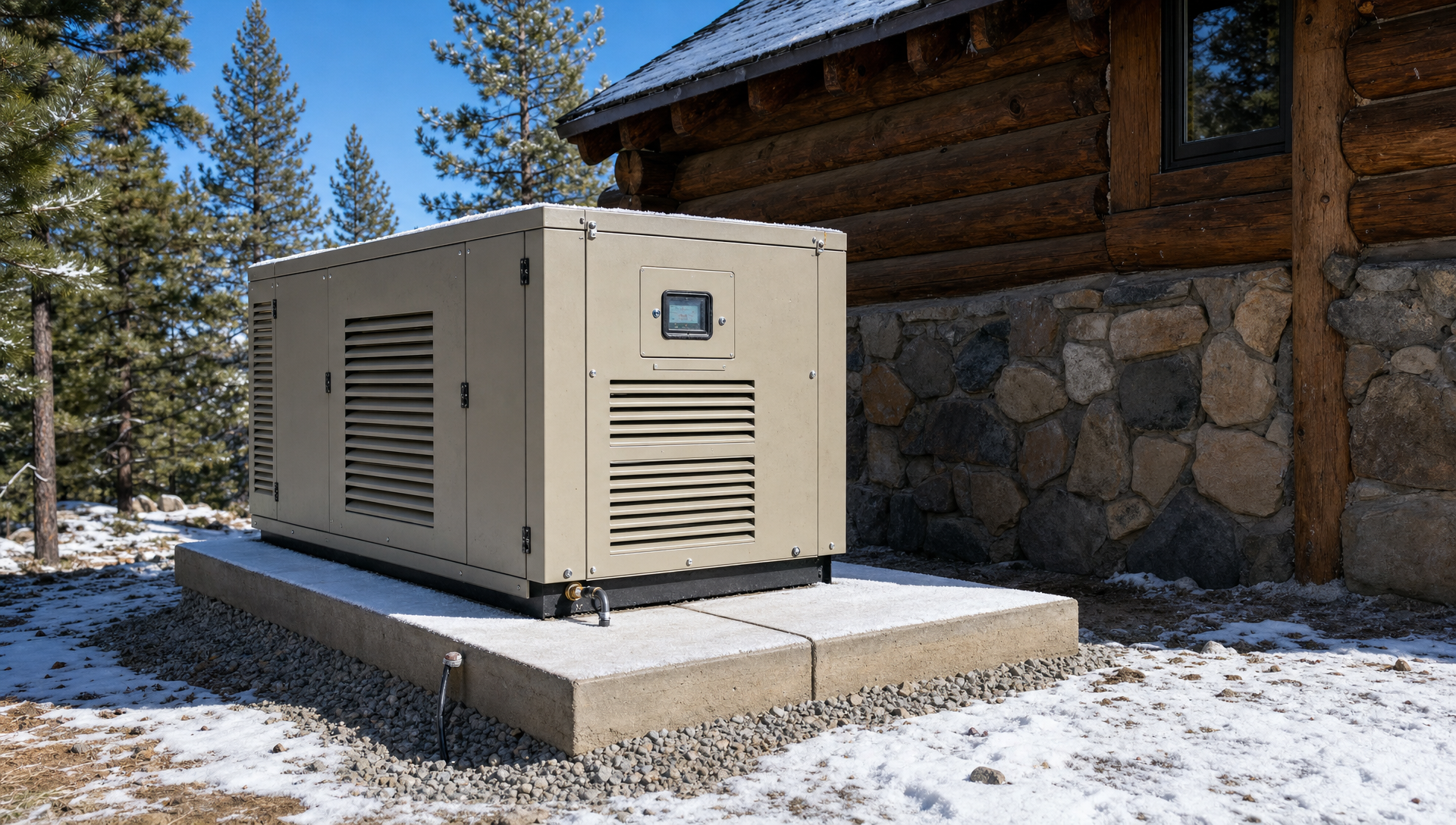
Placement is where a lot of flatland-trained installers get Big Bear installations wrong. A standby generator needs clear air intake and exhaust pathways to run safely and at rated capacity, and a unit mounted at standard ground clearance will get buried under several feet of snow during a heavy Big Bear winter — which can block airflow and, in worse cases, create a carbon monoxide hazard if exhaust can't clear the snowpack. The standard fix is an elevated composite or concrete pad that raises the unit above typical snow accumulation for your specific site, positioned with clearance from rooflines where sliding snow or ice could damage the unit or block its vents. If your property has experienced snow load issues with other outdoor equipment — heat tape circuits, hot tub disconnects, HVAC condensers — the same site assessment should inform generator placement.
How Much Does Backup Generator Installation Cost in Big Bear?
Costs vary by generator type, fuel source, and how much electrical work your existing panel needs, but here's a realistic range for the Big Bear Valley:
- Portable generator with manual transfer switch: roughly $1,000–$3,000 installed
- Essentials-only standby generator (10–14kW, covers critical circuits): roughly $7,000–$11,000 installed
- Whole-home standby generator (22–26kW, sized up for altitude): roughly $11,000–$18,000 installed
- Additional costs common in Big Bear specifically: elevated pad for snow clearance, panel upgrade if your cabin has an older 100-amp panel, and propane tank installation if you're outside Southwest Gas service
Because Big Bear generators generally need to be sized up from a standard calculator to account for altitude derating, expect quotes here to run toward the higher end of national ranges for a comparable amount of covered load — that's the elevation math, not a markup.
Generator vs. Battery Backup: Which Is Right for Your Cabin?
These solve overlapping but different problems. A generator provides continuous power for as long as you have fuel, which matters for extended multi-day PSPS events common during high fire-risk periods. A battery backup system is quieter, requires no fuel logistics, and starts instantly, but has a finite capacity before it needs to recharge — usually not a concern if grid power returns within hours, but a real limitation during a multi-day outage. We cover battery backup specifically in our guide on staying powered through the next BVES PSPS event; many Big Bear homeowners with year-round occupancy or vacation rental obligations end up installing both.
FAQ
Does a backup generator need to be derated for Big Bear's elevation?
Yes. Generator output typically drops 3-4% per 1,000 feet above the manufacturer's baseline elevation, which at Big Bear's 6,750 feet can mean 20-25% less output than the nameplate rating. Always size using the manufacturer's altitude-specific derating curve, not the sea-level rating.
Is propane or natural gas better for a Big Bear backup generator?
It depends on what's available at your specific property. Southwest Gas serves the City of Big Bear Lake and much of the surrounding valley, but more remote cabin areas often rely on propane. Confirm your fuel access before choosing a generator model.
Do I need a permit for a portable generator in Big Bear?
If it's a truly portable unit with no permanent wiring, typically no. But if you're adding a transfer switch or dedicated circuit — which is strongly recommended for safety — that work requires a San Bernardino County electrical permit.
Can I install a backup generator myself?
No. Generator interconnection involves work that, if done incorrectly, can backfeed the utility grid and seriously injure a line worker. California requires a licensed C-10 electrical contractor for this work, and it must be permitted and inspected.
How long does backup generator installation take in Big Bear?
A straightforward portable setup with a transfer switch can often be completed in a day. A whole-home standby generator, including pad preparation, permitting, and inspection, typically takes 2-4 weeks from order to operational, longer if a panel upgrade or propane tank installation is also required.
Should I get a generator or a battery backup system?
Generators are better for extended multi-day outages since they run as long as fuel lasts; battery systems are quieter and lower-maintenance but have finite capacity. Many full-time Big Bear residents and vacation rental owners install both for different scenarios.
Get your backup generator sized correctly for Big Bear's elevation — not a flatland estimate. Big Bear Electric Pros is a licensed C-10 electrical contractor serving Big Bear Lake, Big Bear City, Fawnskin, Sugarloaf, and Running Springs.
Call (909) 415-5573 for a free quote.
Big Bear Planned Power Outage Oct. 16–17: BVES's Timeline, Rolling Blackouts, and What to Do Tonight